NYC Hit 112 Degrees This Summer. Here's What That Means for Your Building's LL97 Penalty.
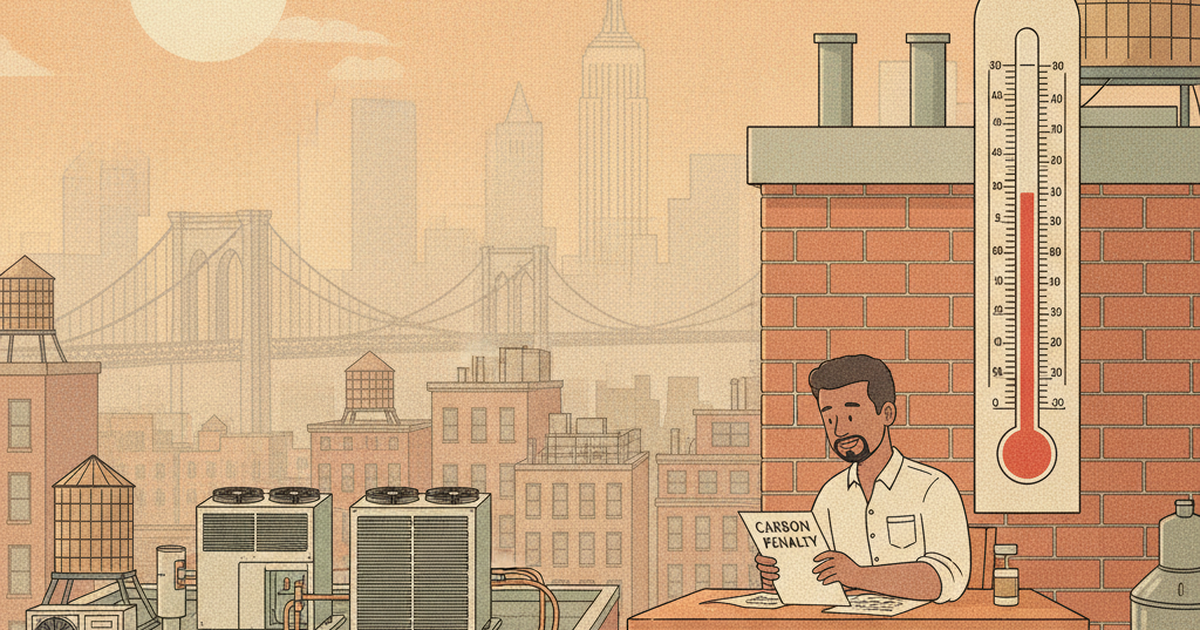
On July 4th weekend 2026, the heat index in New York City hit 112 degrees Fahrenheit. Mayor Mamdani declared an unprecedented heat emergency. Cooling centers opened across the five boroughs. Businesses were asked to set thermostats to 78 degrees.
For most building owners, that week felt like a utility bill problem. For buildings still running steam boilers and window air conditioners, it was also a carbon penalty problem.
Here is why extreme heat amplifies LL97 exposure, and what building owners can do before two key deadlines to reduce both.
How Cooling Electricity Becomes an LL97 Liability
Local Law 97 charges $268 for every ton of CO2 equivalent a building emits above its annual cap. That calculation covers all energy consumed in the building, including the electricity used for cooling.
When a heat wave drives up cooling demand, electricity consumption rises sharply. The more electricity a building draws from the grid, the more greenhouse gas emissions are attributed to it under LL97's carbon accounting rules. A summer like this one doesn't just raise the utility bill. It raises the carbon bill.
LL97's 2030 electricity carbon coefficient is fixed in DOB rules. That means every kilowatt-hour of cooling electricity is counted against the same carbon benchmark whether temperatures are 80 degrees or 112 degrees. During peak heat events, consumption climbs, and so does the LL97 exposure.
Two Buildings, Two Very Different Summers
The LL97 impact of extreme heat depends heavily on what kind of cooling system a building uses.
The typical mid-century multifamily building
Many of the roughly 50,000 NYC buildings covered by LL97 still heat with central steam and cool with individual window air conditioners. During a heat emergency, every window AC unit runs at full capacity. Electricity consumption in these buildings can increase substantially above a typical summer day.
Window AC units are also unmanaged. Tenants set their own thermostats independently, and units vary in age and efficiency. There is no building-wide system to optimize peak demand or reduce consumption during grid-stress events.
The same building with VRF heat pumps
Variable refrigerant flow (VRF) systems handle both heating and cooling with the same equipment. They operate significantly more efficiently than the combination of steam heat plus window ACs, particularly at partial load, which is most of the time.
A building with a modern VRF system cooled the same apartments during the July 4th heat wave while consuming meaningfully less electricity per unit of cooling than a building relying on individual window units. Less electricity consumed means fewer tons of CO2 attributed to the building under LL97.
The VRF building also earns the LL97 Beneficial Electrification Credit. The window AC building does not.
The December 31 Deadline That Turns This Summer Into Action
DOB finalized a provision in LL97's rules that most building owners have not fully processed: heat pumps, VRF systems, and heat pump water heaters installed through December 31, 2026 earn double the LL97 compliance credit compared to the same equipment installed on January 1, 2027.
After December 31, 2026, the credit is cut in half through 2029, then disappears entirely starting in 2030. A building that waits one day earns half the benefit.
For a building over its 2030 carbon cap, the difference between double and standard credits can determine whether it owes penalties every year from 2030 to 2034, or avoids them. According to the Urban Green Council's analysis, the value of double versus standard credits can reach hundreds of thousands of dollars in avoided 2030-period penalties for large buildings.
A 112-degree heat index is the most visceral argument yet for acting before that deadline.
The Incentive Stack Available Right Now
The BEC double credit reduces your future LL97 penalty exposure. Three other programs reduce the upfront cost of getting there, and two of them have deadlines before December 31.
Con Edison Multifamily Heat Pump Incentives (Deadline: November 1, 2026)
Con Edison's 2026 multifamily program offers heat pump incentives of up to $10,000 per unit. Market-rate multifamily projects are capped at 70% of project cost or $1 million. Affordable housing (AMEEP) projects can reach 85% of project cost or $1 million, with additional per-unit incentive amounts available.
The installation deadline is November 1, 2026. Funding is first-come, first-served. Earlier applications have greater certainty of capturing current-year program rates. Check eligibility directly with Con Edison before applying.
NYSERDA Multifamily Heat Pump Rebates (Ongoing)
As of January 1, 2026, buildings with five or more units must apply through NYSERDA's commercial and multifamily track for clean heat rebates. Current published amounts are up to $7,000 per unit for heat pump installations and up to $1,000 per unit for heat pump water heaters. Check current eligibility and amounts directly with NYSERDA, as program terms are subject to change.
For a 20-unit building, published program rates suggest up to $160,000 from NYSERDA alone, before Con Edison rebates or BEC credits are added. Building owners who have only looked at the residential NYSERDA page will not find this program there: the 5+ unit track is separate.
C-PACE Financing (No Cash Upfront)
For buildings where capital is the constraint, C-PACE financing covers up to 100% of project costs with no cash upfront, repaid through the property tax bill over 20 to 30 years at a fixed rate. The first NYC co-op C-PACE deal closed in April 2026 for a $1 million heat pump conversion. The 2024 program amendment expanded eligibility to include all-electric major renovations and new construction.
When NYSERDA and Con Edison rebates are applied to the total project cost before financing, the remaining amount to be financed through C-PACE can be significantly lower. For some buildings, the combined programs cover a substantial portion of the project cost.
One More Reason to Electrify Now: the Grid Is Getting Cleaner
There is a second benefit to electrifying in 2026 that is easy to miss. On May 13, 2026, the Champlain Hudson Power Express (CHPE) reached commercial operation. This 1,250-megawatt transmission line delivers clean Canadian hydropower directly to Astoria, Queens.
At full capacity, CHPE can supply roughly 20% of NYC's annual electricity demand. Buildings that electrify now benefit twice: the heat pump is more efficient than fossil fuel heating or unmanaged window ACs, and the grid electricity powering it is getting meaningfully cleaner.
LL97's 2030 electricity carbon coefficient is fixed in DOB rules and does not change dynamically with grid improvements. But the underlying assumption that NYC's grid would decarbonize significantly by 2030 is now being borne out. This strengthens the long-term case for electrification over relying on renewable energy credits.
The Lead Time Problem
November 1 for Con Edison and December 31 for the BEC double credits both sound like enough runway. For many buildings planning large central systems, they are not.
Large commercial heat pump systems carry equipment lead times of 3 to 12 months. NYC permit approvals for HVAC work typically run 3 to 6 months. Contractor schedules in the city's HVAC market are tightening as more buildings move toward 2030 compliance.
What can still be completed before December 31, 2026:
- Heat pump water heater installations: Shorter lead times, often completable within the current calendar year.
- Room and window heat pumps in smaller buildings: Plug-and-play units requiring no new electrical infrastructure can often be installed within weeks of ordering.
- Phased electrification: Installing qualifying equipment in part of the building before December 31 locks in double credits for that portion. Remaining phases earn standard credits in 2027 to 2029.
- Buildings already in permitting: Projects that started design and permit work earlier in 2026 may still have a realistic path to completion this year.
What to Do in the Next 30 Days
- Get your 2030 penalty estimate. If you don't know how far over your 2030 cap your building currently sits, start there. CompliantLens shows the estimate using public benchmarking data. Check your building (free).
- Book an energy audit. NYSERDA's FlexTech program covers up to 50% of audit costs (100% for buildings in Disadvantaged Communities). An audit is the prerequisite for sizing a VRF or heat pump system and for applying to Con Edison rebates.
- Contact Con Edison's multifamily program. The November 1 installation deadline sounds distant, but commercial heat pump lead times often are not. Apply early to secure your place in the funding queue. Con Edison heat pump program.
- Start the NYSERDA application. The commercial and multifamily track has its own enrollment process. Starting now avoids the year-end rush as more buildings move toward 2030 compliance.
- Explore C-PACE if capital is the constraint. The NYC Accelerator offers free consultations and connects building owners with approved C-PACE lenders. NYC Accelerator PACE page.
The Bottom Line
A 112-degree heat index on the Fourth of July was not a freak event. NYC is investing significantly in heat-protection infrastructure because extreme heat is becoming a structural feature of the city's climate, not a one-time outlier.
Buildings that handle both heating and cooling with the same efficient electric system are in a fundamentally different position under LL97 than buildings with central steam and individual window ACs. The first earns double compliance credits through December 31, 2026, runs more efficiently during heat events, and benefits as the grid gets cleaner. The second pays more in summer electricity and more in annual carbon penalties.
The deadline to capture the double BEC credit is December 31. The deadline to capture Con Edison rebates is November 1. An energy audit needs to happen now for either to be feasible. This summer made the business case for acting. The calendar sets the deadline.
Check your building's LL97 exposure (free)
Sources: NYC Mayor's Office, heat emergency declaration and cooling center announcements (July 2026) (nyc.gov/mayors-office/news/2026/07/mayor-mamdani-expands-emergency-heat-measures-to-protect-new-yor); Urban Green Council, "LL97's New Game-Changing Electrification Credit" (urbangreencouncil.org/ll97s-new-game-changing-electrification-credit/); NYC Department of Buildings, Local Law 97 beneficial electrification credit rules and carbon coefficient (nyc.gov/site/buildings/codes/ll97-greenhouse-gas-emissions-reductions.page); Con Edison 2026 Multifamily Heat Pump Incentive Program (coned.com/en/save-money/rebates-incentives-tax-credits/rebates-incentives-for-multifamily-customers/electric-heating-and-cooling-technology-for-multifamily-buildings/heat-pump-incentives); NYSERDA Heating and Cooling Programs, commercial and multifamily track (nyserda.ny.gov/PutEnergyToWork/Energy-Program-and-Incentives/Heating-Cooling-Ventilation-Programs-and-Incentives); NYSERDA Tier 4 Program, CHPE commercial operation (May 13, 2026) (nyserda.ny.gov/All-Programs/Large-Scale-Renewables/Tier-Four); Urban Green Council, NYC Grid in Transition (urbangreencouncil.org/nyc-grid-in-transition/); NYC Accelerator C-PACE program (accelerator.nyc/resources/finance/PACE); NYC Administrative Code §28-321.2 (LL97 penalty rate $268/tCO2e). Dollar amounts reflect maximum published program rates and are estimates only; they do not constitute a guarantee of rebate eligibility, savings, or any specific outcome. Check current eligibility and amounts with the applicable program administrator. This content is for informational purposes only and does not constitute legal, tax, or financial advice. Consult qualified professionals regarding your building's specific LL97 compliance obligations and incentive eligibility.